

Sell it at full price before it becomes a markdown.
Every week, BOOST reads your storefront and ranks the full-price styles with the most money still on the floor and the size run still intact. One click turns any of them into a short training video your stores can watch before the next shift.
Get your shortlistTell us your brand. We send back this week's shortlist. Nothing to install, no system access.

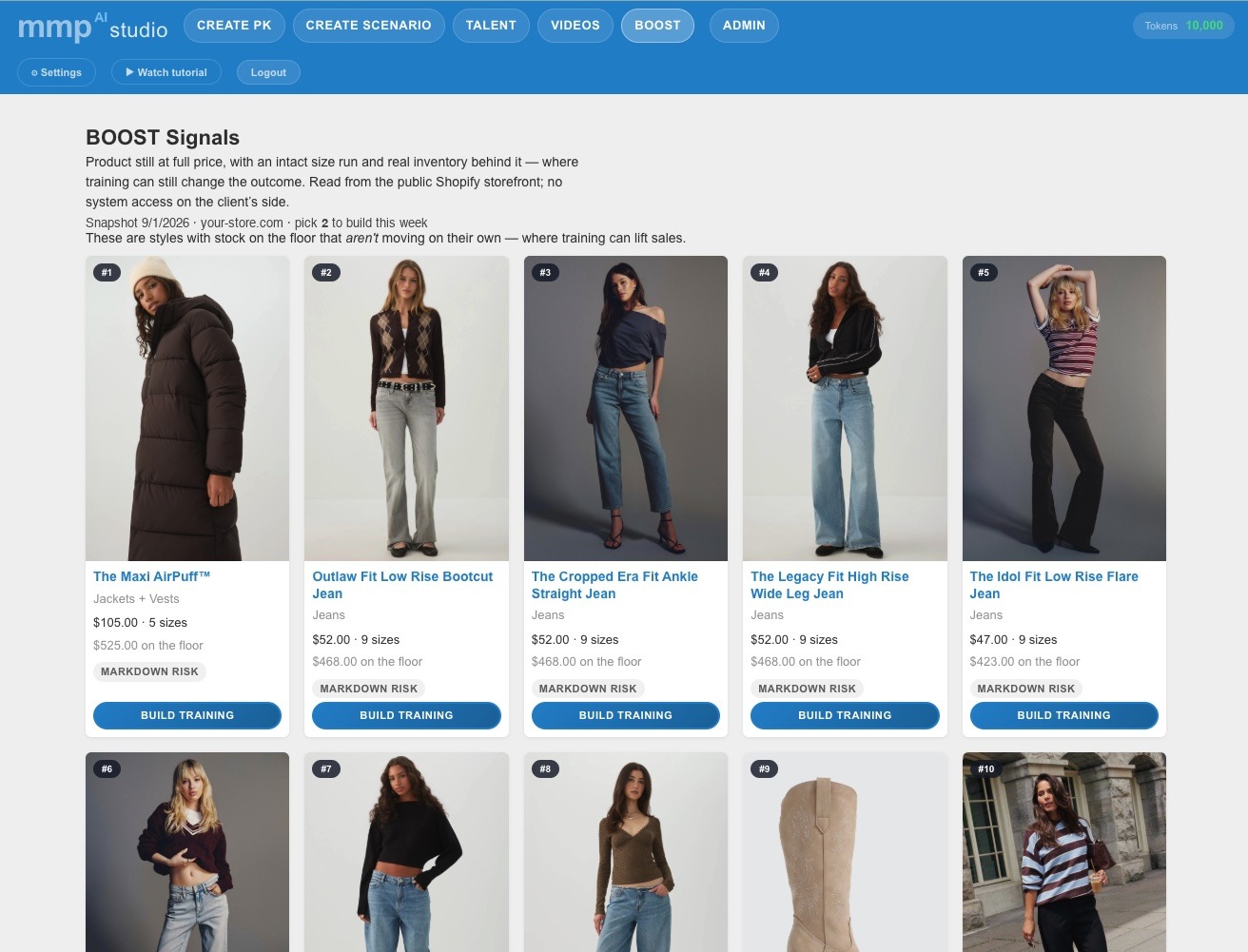
A real week's shortlist. Each card shows the full-price value behind the style, the sizes still in stock, and a one-click Build Training.
Markdowns are the biggest margin leak you can still control.
The inventory is bought, the size run is on the floor, and the selling window is a few weeks long. Whatever doesn't sell at full price in that window gets sold at a discount.
spent each year by fashion retailers worldwide on in-season and end-of-season markdowns.1
drop in markdown rate in one fiscal year at a specialty apparel retailer after product training was timed to each delivery.2
higher sales for associates who completed three short online training modules, in a two-year Wharton study.3
Markdown software decides how much to cut. BOOST works on the step before.
Pricing and markdown-optimization tools answer when to discount and how deep. They start from the assumption that the style isn't going to sell.
BOOST starts earlier. It finds the styles where the money is still on the floor and the sizes are still there, then gives the people on your sales floor a reason to sell them at the price you planned.
Changes the price. Recovers part of the margin after the style stalls.
Changes the selling. Protects full-price margin while the style is still in its window.
From your storefront to the sales floor in a week.
BOOST reads your storefront
Each week it reads your public site and ranks full-price styles by the value still on the floor and the health of the size run. Clearance and excluded categories are filtered out.
You pick the styles
Your merchants choose which styles to push this week. Each card already carries the product imagery, price and sizes, so there's no brief to write.
Stores get the training
One click builds a short product video for associates: what it is, who it's for, how to fit it and how to sell it. It reaches the floor while the style can still sell at full price.
Markdown rate as a share of sales, in one fiscal year. Markdown spend fell about 25% year over year, more than three times faster than sales declined.
The change: product knowledge training for every associate in the full-price fleet, timed to land with each delivery instead of after the season.
“Training that arrives after the season is a report card; training that arrives with the product is a sales tool.”
For the people who own the markdown line.
GMMs, DMMs, buyers and category managers already know which styles they need to move. BOOST gives them a way to act on it in stores this week, without waiting on a training calendar.
- A weekly ranked shortlist for each of your sites
- The full-price value and sizes in stock behind every style
- Training built from your own product imagery and copy, in your brand's voice
- Delivered to associates on the phone or tablet they already use
Shopify and Salesforce Commerce Cloud.
Shopify
BOOST reads your public Shopify storefront directly. No app, no API keys.
Salesforce Commerce Cloud
Formerly Demandware. BOOST reads your public product pages today, with nothing needed from you. Add a direct catalog connection any time by issuing an API client.
Something else?
Most modern storefronts publish the product data BOOST needs. Tell us your site and we'll tell you what we can read.
See this week's shortlist for your own brand.
Tell us who you are and we'll send back the styles BOOST would flag on your site this week, with the full-price value and sizes behind each one. Free, and nothing to install.
Sources
- Boston Consulting Group, “The Advanced Analytics Behind Fashion Company Markdowns,” 2020. bcg.com
- Multimedia Plus, “Case Study: Markdown Rate Down 17.7% Year Over Year.” Figures from the retailer's weekly performance reporting; training was mandatory for all associates, so there was no control group. multimediaplus.com
- Fisher, Gallino and Netessine (The Wharton School), “Does Online Training Work in Retail?” A two-year study. ssrn.com